
DIVE-IN:
The CoastX Blog
January 2026
Winter Under The Piscataqua - Nudibranch season!
Matt Scheuer, CoastX Co-Founder
As winter descends on the Piscataqua River, sunlight diminishes and water temperatures plunge to half of what they reach in the summer. The estuary changes drastically as cold nights bring ice creeping over the shallow inlets. Blooms of phytoplankton that color our harbors deep green during the summer die back, leaving clear visibility through the water. Fish move out to deeper habitats. Crustaceans slow down. My head aches as the frigid sea flushes between my scalp and neoprene dive hood. Yet life continues below, and for some creatures such as nudibranchs, winter is their time to thrive.
Nudibranchs are sea slugs, often small, but decorated with luminous color and ornate frills to ward off predators in lieu of a shell. While neurologically simple, these animals have evolved sophisticated behavioral, cellular, and chemical adaptations to survive. Nudibranchs are the main attraction for winter diving in the Piscataqua. Divers brave the icy waters to appreciate the exquisite beauty of these cryptic creatures, and for the challenge of finding, photographing, and identifying the dozens of local species.
Nudibranchs tend to grow larger and more abundant in the Piscataqua River than in surrounding areas. I don’t know exactly why. One possibility is the abundance of their food sources here. Most nudibranchs are highly specialized predators, adapted to just one or two very specific types of prey. Some consume sponges, bryozoans, or anemones. We have one known as the “barnacle-eating nudibranch”. Many feed on hydroids, which flourish in the fast-moving, plankton-rich waters of the Piscataqua.
Hydroids are simple animals related to jellyfish, anemones, and corals. They can take many forms (check ‘em out on Wikipedia) but most local varieties live as individual polyps or branching colonies on seaweed or hard substrate. The Piscataqua hosts a diverse cast of hydroids, from the tiny “snail fur” that adorn periwinkle shells like coats of velvet, to the large tubularians which look like undersea bushes of pink flowers swaying in the tideflow. Like their jellyfish relatives, hydroids have stinging cells armed with nematocysts. These work like microscopic spring-loaded harpoons to inject venom into predators or prey. Hydroids use their tiny stinging tentacles to feed on microscopic zooplankton, and nudibranchs chow down on hydroids (their mucus protecting them from the stingers).
In one of nature’s most extraordinary adaptations, certain nudibranchs have evolved the astonishing ability to actually capture and utilize hydroid stinging cells. These nudibranchs eat hydroids, then transport any immature unfired stinging cells through their digestive tracts and into the tips of cerata (fleshy fronds) on their own backs. There the nudibranchs can maintain the living cells of an entirely different animal, incorporated as a fully-functional defense mechanism ready to zap any fish that takes a pass. Another local sea slug plays a similar trick with the algae it eats, consuming the chloroplasts and hosting them inside its own emerald-green body to photosynthesize sugars just like a plant.
Scientists have described roughly 3,000 species of nudibranch worldwide, with more discovered every year. Shockingly little is known about the life cycle of these creatures, and new research is constantly unveiling bizarre details of their intricate lives. We haven’t even figured out what all of the local species are, let alone the unique diets and reproduction habits of many. For curious explorers of the Piscataqua River, a vibrant and otherworldly ecosystem bustles beneath the surface, full of beauty and tantalizing scientific opportunity, ready to be discovered all year round.
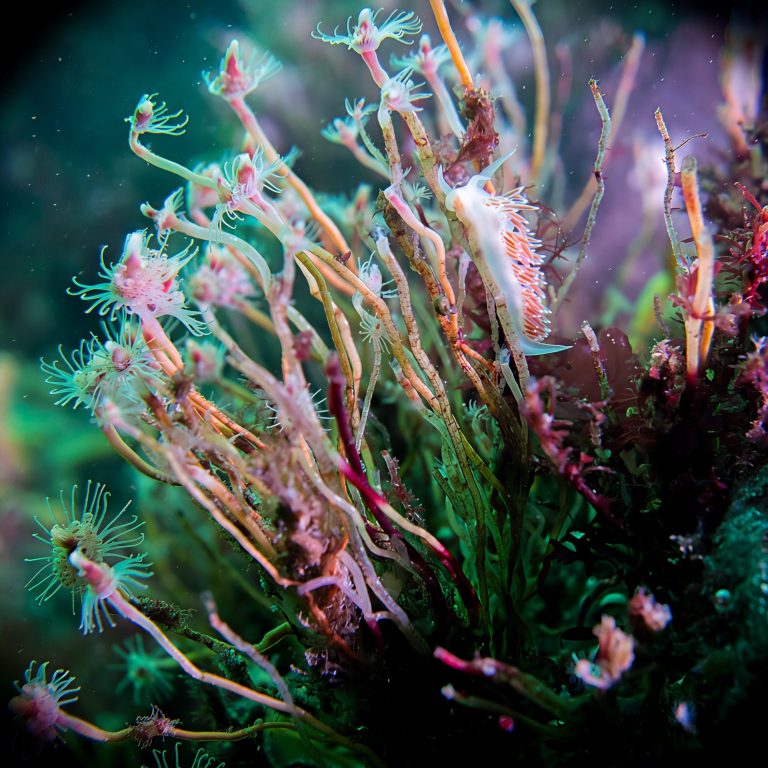
Top image: A red finger aeolis nudibranch (Coryphella verrucosa) feeding on tubularia hydroids in the Piscataqua.
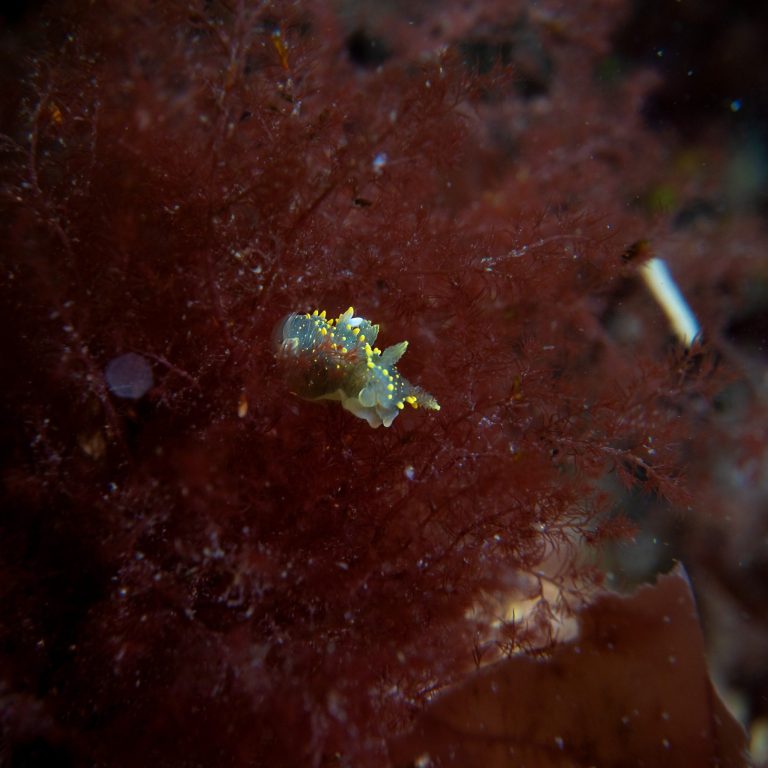
Bottom image; Rim-back nudibranch (Palio dubia)