Ocean Journal
The CoastX Ocean Journal
Eelgrass: The Underwater Meadows That Keep Our Coast Healthy
The Ocean Journal was written by Ana Brunette as part of her Summer Internship with CoastX.
If you've been following our Ocean Journal, you may remember that we briefly mentioned eelgrass in our Ocean Discovery Week 1 recap. While aboard the M/V Utopia, students learned about eelgrass and why this underwater habitat is one of the most important ecosystems in the Gulf of Maine. It was just one of many discoveries made throughout the week—but eelgrass is so important that it deserves a closer look.
At first glance, eelgrass (Zostera marina) may not seem all that remarkable. It looks like long strands of green grass swaying beneath the water's surface. But beneath its simple appearance lies one of the most valuable habitats along the New England coastline. Often called an underwater meadow, eelgrass provides shelter for marine life, protects shorelines, improves water quality, and helps keep our oceans healthy.
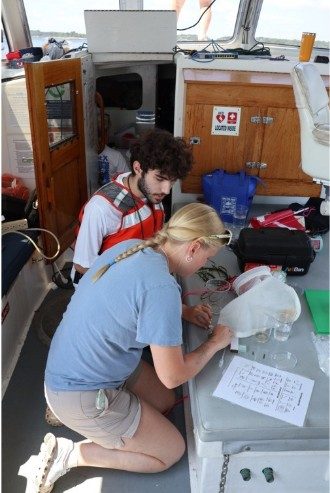
Eelgrass expert Addie Stanley from PREP working with a student to examine collected eelgrass under a microscope.
What Is Eelgrass?
Although it resembles seaweed, eelgrass is actually a flowering marine plant. It grows in shallow coastal waters where sunlight can reach the seafloor, allowing it to photosynthesize just like plants on land. Throughout the Gulf of Maine, eelgrass forms dense underwater meadows that create habitat for countless marine species.
These meadows are some of the most productive ecosystems in our coastal waters. Every blade provides hiding places for young animals while creating surfaces where tiny organisms can live and grow. Together, they form thriving underwater communities that support an incredible diversity of life.
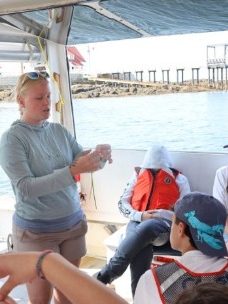
Eelgrass expert Addie Stanley from PREP talking to students about the importance of eelgrass.
Why Does Eelgrass Matter?
One of eelgrass's most important roles is serving as a nursery for juvenile marine life. Young fish, crabs, scallops, lobsters, and many other species spend the earliest stages of their lives sheltered among the blades, where they are protected from predators while they grow.
Eelgrass also improves water quality by slowing currents and allowing suspended sediment to settle to the seafloor. Clearer water allows more sunlight to reach underwater plants, helping entire coastal ecosystems thrive.
Its extensive root systems anchor sediment in place, helping reduce shoreline erosion and soften the impact of waves and storms. Healthy eelgrass meadows don't just benefit marine life—they help protect our coastlines, too.
Another remarkable benefit of eelgrass is its ability to capture and store carbon dioxide. Like forests on land, eelgrass removes carbon from the atmosphere and stores it in its leaves, roots, and the surrounding sediment. Scientists refer to this as blue carbon, an important natural process that helps support climate resilience.
An Ecosystem Worth Protecting
Despite its importance, eelgrass is disappearing from many coastal areas. Pollution, nutrient runoff, declining water quality, coastal development, warming ocean temperatures, and disease have all contributed to the loss of eelgrass meadows throughout New England.
When eelgrass declines, the effects are felt throughout the ecosystem. Marine animals lose critical nursery habitat, shorelines become more vulnerable to erosion, and one of nature's most effective carbon storage systems begins to disappear.
Because of this, scientists closely monitor eelgrass populations. Changes in eelgrass health can reveal important information about the overall condition of coastal waters and help guide conservation efforts.
Eelgrass expert Addie Stanley from PREP explaining an eelgrass sample taken from the seafloor via ROV.
Learning Beyond the Classroom
One of the most valuable parts of CoastX's Ocean Discovery program is experiencing these ecosystems firsthand. While aboard Utopia, students used a remotely operated vehicle (ROV) to explore underwater environments and collect samples of eelgrass from the seafloor. Once the samples were brought back onboard, students examined them under a microscope, getting an up-close look at a habitat they had just explored beneath the surface.
This hands-on experience connected technology, exploration, and marine science in a meaningful way. The ROV allowed students to investigate areas that would otherwise be difficult to access, while the microscope revealed details of the eelgrass that couldn't be seen from above the water.
By collecting, observing, and discussing the samples, students gained a deeper appreciation for why scientists study eelgrass and how this seemingly simple plant supports an entire coastal ecosystem. It's one thing to learn about eelgrass in a classroom—it's another to collect it from the ocean yourself and examine it just moments later aboard a research vessel.
Looking Beneath the Surface
Eelgrass may not be the first thing that comes to mind when you think about the ocean, but its impact is enormous. These underwater meadows provide homes for marine life, improve water quality, protect coastlines, and store carbon—all while quietly growing beneath the waves.
The next time you look out across the Gulf of Maine, remember that some of the ocean's most important ecosystems are hidden just below the surface. Sometimes, the most extraordinary discoveries begin with looking a little closer.
Want to experience marine science firsthand? Through CoastX's Ocean Discovery program, middle and high school students work alongside marine scientists, use real research tools, explore coastal ecosystems aboard Utopia, and discover the incredible habitats that make the Gulf of Maine so unique.
Check out the PREP website and what they’re doing for eelgrass here.